
The History We Must Honor: Why We Give Her Flowers, Mother's Day.

Updated: May 13

When Mother’s Day was officially established in the United States in 1914, it was envisioned as a day of peace — a time to honor the sacrifices mothers made for their children.
Anna Jarvis, the founder, campaigned tirelessly for a day dedicated to the sentimentality of motherhood, symbolized by the wearing of a white carnation.
It was a beautiful idea, but like much of American history, it was an idea built on a foundation of exclusion.
In 1914, the American definition of “motherhood” was fragile, protected, and overwhelmingly white.
The mothers being celebrated with breakfast in bed and delicate carnations were not the women who had spent centuries nursing the nation’s children while their own were sold away.
They were not the women whose bodies were treated as capital, whose labor built the wealth of the country, and whose maternal rights were legally non-existent.
Historically, the African American mother was excluded from the national narrative of reverence.
She was the nanny, the mammy, the laborer, the backbone — but rarely the honored matriarch in the eyes of the country she helped build.
The African American mother does not bloom with fragile, showy petals.
Her strength is older, deeper, rooted in ancestral soil.

There is a story from the Route des Esclaves, the road of the enslaved, where captives were forced to walk in circles around the sacred Iroko tree — the Tree of Forgetfulness.
The slavers called it preparation.
A stripping away of identity before the ships.
But the enslaved carried another truth.
They did not forget who they were.
They prayed for what would return.
They packed their memories, their names, their songs, their recipes, their rhythms, their God, and their resilience densely into the core of their spirits — just as the Iroko packs its strength into its wood.
Like the Iroko, the African American mother has never had the luxury of being merely decorative.
Her love, her legacy, is wind-pollinated.
Stripped of the soil she knew, scattered across oceans and generations, she learned to release her children, her teachings, and her prayers into the unseen currents of a harsh wind.
She trusted that what she had packed into them — the whispered prayers, the warnings, the standards, the songs, the hands laid on foreheads — was enough to take root, stand tall, and thrive.
But her roots did not just hold her own family steady.
They anchored a new world.
The African American mother mothered America.
With her hands deep in the soil of Big Sugar and King Cotton, she cultivated the wealth of a nation. With her body, she birthed generations into bondage. With her arms, she nannied the children of those who claimed ownership over her.
She nursed, raised, fed, corrected, comforted, dressed, and steadied a growing country that took her labor, her milk, her children, her genius, and her softness — then left her unnamed in its history books.
She was behind the kitchen door.
Behind the cradle.
Behind the cotton.
Behind the sugar.
Behind the original couture of a nation that was dressed, pressed, fed, and held together by hands it refused to honor.
This is why, today, it is absolutely essential that we are forward, intentional, and unapologetic in our honor.
We cannot rely on a generalized holiday to capture the depth of what the African American mother has endured and achieved. When we celebrate her, we are not just participating in a Hallmark tradition. We are actively reclaiming a narrative.
We are acknowledging the centuries of uncredited labor, fierce protection, and expansive love that mothered a people through the unimaginable.
Through it all, she redefined what it means to mother.
Mothering is not only the act of birth.
It is the commitment to be present.
It is the profound generosity of your soulful humanness.
It is the Grandmom who raises a second generation.
The stepmom and modern-day bonus mom who choose to love without boundaries.
The godmom who stands in the gap.
The pet ma who nurtures with quiet devotion.
The lunchroom mother who makes sure every child feels seen and fed.
The church mother whose correction is love in a sturdy coat.
Mothering is a verb.
An expansive canopy, like the Iroko tree, sheltering whoever needs to rest beneath it.
Even in the highest rooms, mothering remains layered.
Justice Ketanji Brown Jackson, the first Black woman to serve on the United States Supreme Court, has spoken with honesty about the sacred tension between public authority and private motherhood — how the robe may command a courtroom, but daughters still call a mother back to patience, humility, humor, and home.
Her story reminds us that achievement does not replace mothering.
It reveals how much a woman is often carrying at once.
Motherhood is not a box of chocolate candy.
It is not fleeting sweetness.
It is legacy.
It is the deep, enduring root that holds the family tree steady through the storm, even when the soil is unforgiving.
My own anchors have gone on to sit at the base of that majestic Tree of Forgetfulness in glory.
I carry them with me, and in me, as part of my granted freedoms.
I was honored to meet and take in the one-of-one essence of the selfless Mother Clara Hale, and I carry the gift of her signature with me still.


Poet Mari Evans wrote in "I Am a Black Woman" with force, dignity, and truth about Black womanhood.
That spirit lives here too.
Because Black women have mothered families, communities, and this country itself — often without ceremony, often without rest, and still with beauty, standards, grace, and a strength this world has too often expected without fully honoring.
I am the fruit of the flower.
So today, we give her Her Flowers.
We give them in many forms — freshly cut, beautifully printed, or carefully handcrafted.
Because flowers are not just pretty. They are workers of life — feeding, pollinating, seeding, and helping the earth continue.
And while her strength never required delicate blooms to survive, today those blooms serve a different purpose.
Today, they whisper:
Thank you for the carrying.
Thank you for the covering.
Thank you for the correction.
Thank you for the food.
Thank you for the prayers.
Thank you for the softness you gave, even when the world gave you none.

At VSG, Her Flowers can be freshly picked, printed to be worn, or handcrafted into jewelry with The Look of Real.

A floral earring.
A soft scarf.
A golden piece that catches the light.
A small gift chosen with intention.
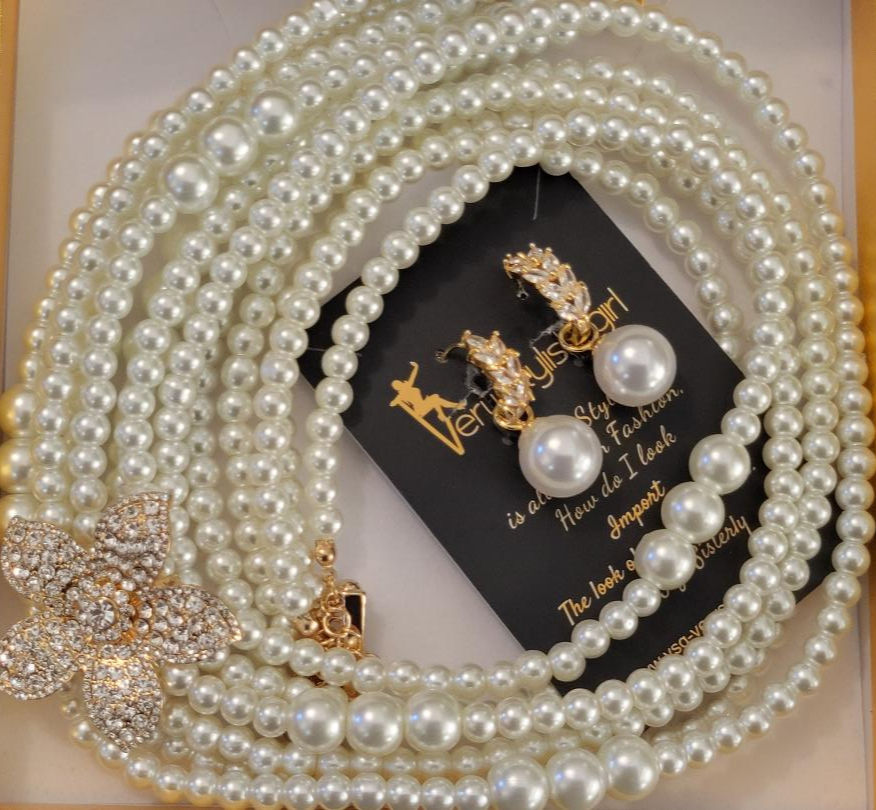

Not because anything can repay her — but because the gesture should rise to meet the love.
This Mother’s Day, honor the women who mothered you by birth, by choice, by care, by courage, or by presence.
Give her Her Flowers.
All of her deserves them.
Happy Mother’s Day.
Share your thought below. Your voice belongs in The X-Factor.


Comments