
I Traveled 7,392 Miles to India — And Learned What Belongs at VSG

Updated: 12 hours ago

VSG in India, Part One: New Delhi — The Gateway Into My India Story
After four decades in fashion, I traveled 7,392 miles to India looking for something different—beyond the showroom and closer to the source. What I found changed how I buy. Not more merchandise, but pieces worthy of VSG. I met makers, studied the craftsmanship and came home clearer about what belongs here.
India was not simply another stop on an itinerary.
For more than four decades, I have worked in retail—buying, merchandising, and styling fashion for women.
Throughout my career, I purchased many products made in India, but those purchases usually came through vendors, showrooms, importers, and other people positioned between the buyer and the place where the work began.
This trip was different.

I wanted to move beyond the samples, sales appointments, and polished presentations.
I wanted to visit factories, examine workmanship for myself, ask direct questions, and better understand what happens before a product reaches a showroom, a store, or a website.
I wanted to get closer to the source—without a middle person interpreting the experience for me.
What I discovered shifted more than my sourcing plans.
It changed how I thought about production, value, tradition, workmanship, and the many hands a product may pass through before it reaches the woman who finally wears it.
I also arrived knowing far less about Indian culture than I wanted to know.
So join me as I step into a country filled with color, movement, devotion, workmanship, contradiction—and more people than I had ever seen moving through one place at once.
New Delhi was the gateway into my India story and the first stop on a three-city journey through India’s Golden Triangle: Delhi, Agra, and Jaipur.
I arrived as a traveler.
I also arrived as an African American woman from Queens—7,392 miles from home, representing a young, independent business built for women too often overlooked.
I had come not only to see India, but to move beyond the showroom, stand closer to the source, and decide for myself what was worthy of the VSG.
I carried the same eye I have used throughout many decades of buying, merchandising, and styling—looking closely at color, fabrication, workmanship, proportion, value, and whether a piece could genuinely serve the VSG woman.
Because VSG does not buy something simply because it is Nice.
Nice gets my attention.
Purpose earns the purchase.
A City Moving in Every Direction
Delhi moved around me from every direction.
Old Delhi and New Delhi.
Historic buildings beside modern development.
Cars, motorcycles, people, animals, merchants, guards, street vendors, and moments of quiet devotion—all existing at once.
I saw cows from the car window and moved through traffic alongside elephants.

I drank chai from a clay cup near members of Parliament.
I stood in spaces where history had not been packed away behind glass; it remained woven into daily life.


India humbled me.
The volume of people.
The depth of its traditions.
The visible contrast between wealth and work.
The way extraordinary beauty could appear beside hardship without asking permission.
There was always something happening—and beneath all that movement, something enduring.
I was reminded that the world can keep changing without tradition completely disappearing.
The new may arrive, but the old continues to speak.
That stayed with me.
I had come to understand fashion production more closely, but India was already teaching me something larger: products do not begin in stores.
They begin inside cultures, communities, workshops, factories, markets, and families.
They carry labor, history, materials, decisions, and hands that the final customer may never see. That realization followed me into every buying conversation.
I Did Not Go Only to Look.
I went to work.


After four decades of buying fashion produced in India through other channels, I was finally able to step closer to the process for myself.
I shopped for fabrics and trims.
I entered a factory.
I examined construction up close.
I asked questions about production, minimum quantities, freight, duties, importing, and what the final landed cost would mean for VSG.
There was no showroom presentation smoothing the edges.
I could see both the possibilities and the complications more clearly.
And what I discovered was perspective-shifting. The total cost of importing clothing would have pushed the final retail price beyond what made sense for my customer.
That is part of the real sourcing story too.
A buying trip is not successful only when you return home with large orders.
Sometimes success is recognizing what does not belong in the assortment.
Sometimes the smartest purchase is the one you are disciplined enough not to make.
I will not bring clothing into VSG simply so I can say it came from India. The quality, fit, cost, and final value must still make sense for the woman purchasing it.
That is the difference between shopping and buying professionally.
Shopping asks:
Do I like it?
Buying asks:
Does it belong here—and does it serve her?
That answer must include more than beauty.
It must include fit.
Function.
Quality.
Price.
Purpose.
And whether the woman wearing it will feel considered.
Then the Story Changed
With the guidance of my Kashmiri guide, I was introduced to special vendors and smaller collections I would not have discovered on my own.

That is where the story changed.
I found earrings, bracelets, scarves, and special sets produced in very limited quantities. Some were genuine one-of-one finds.
Others were available only in small, short runs.
They had color.
Scale.
Detail.
Presence.
But before I purchased anything, I inspected it.
I touched each piece.
I turned it over.
I studied the finish, the construction, the weight, and the workmanship.
Because pretty is not enough.
I needed to know it was worthy of you.
Only then did I ask for a receipt.
That receipt meant more than proof of purchase.
It meant the piece had passed through my hands, my questions, and my trained eye before it could arrive at VSG.
I am excited to share these treasures with you—not only because they are beautiful, but because I now understand more of the journey behind them.
These are the pieces I touched, examined, questioned, and selected after traveling 7,392 miles to look beyond the showroom and closer to the source.
I see you, girl. I am you.
The First India Drop
These pieces were selected for the woman who understands that an accessory does not have to whisper itself away.
She appreciates an earring with enough scale to frame her face.
A bracelet that gives her arm presence.
A scarf with enough length, movement, and beauty to finish the look without making her feel hidden beneath it.
She knows that some jewelry is meant to become an heirloom—and some is meant to make this season shine.
Both have a place.
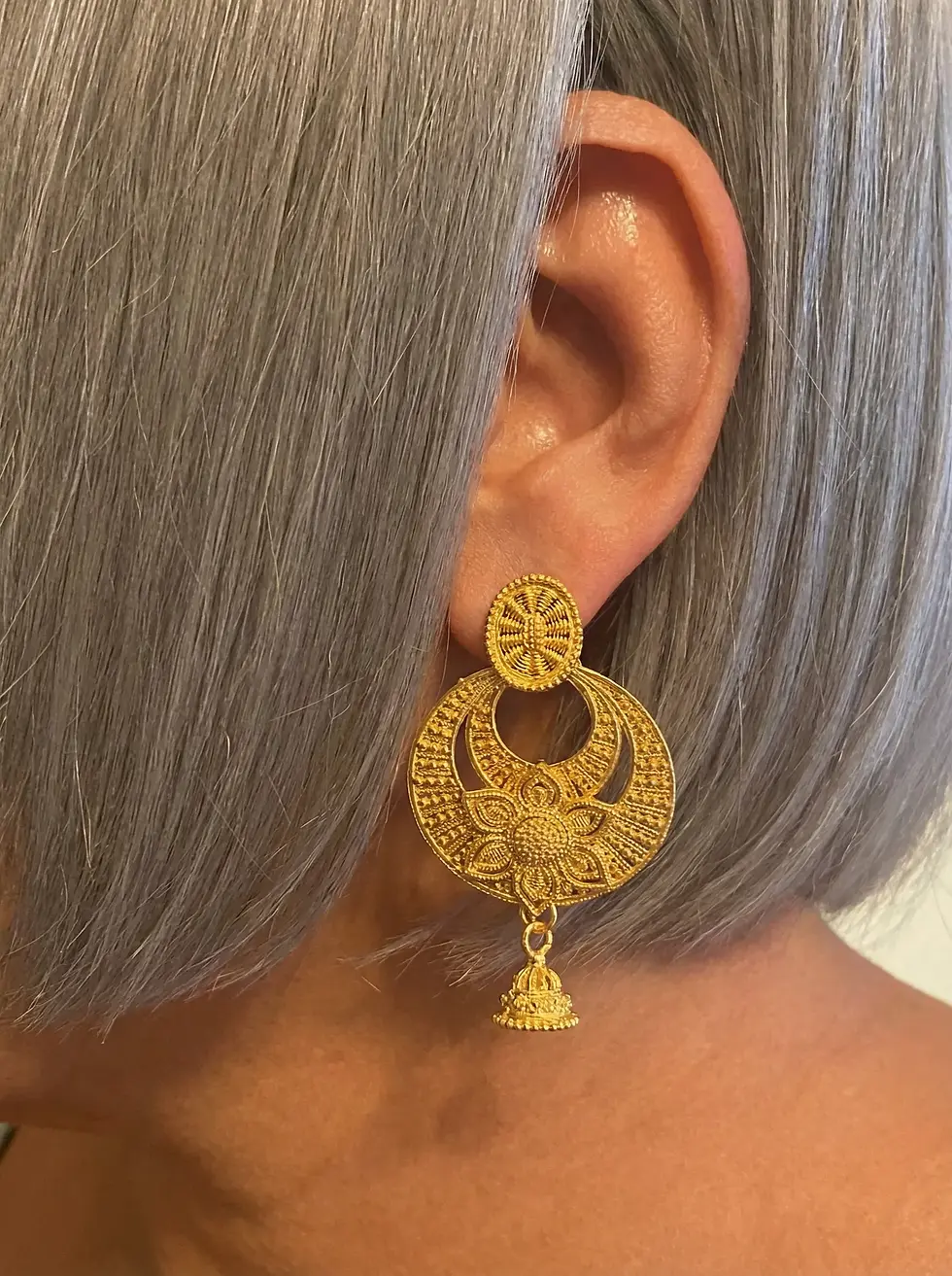
The first India drop includes limited-quantity statement earrings, arm candy, and artful scarves chosen for their detail, movement, color, and grown-woman impact.
They offer the look of real with the freedom of fashion jewelry—pieces selected for this season, this outfit, this trip, this dinner, this entrance, and this version of you.
India Statement Earrings
Bold face framers.
Rich gold-tone finishes.
Intricate filigree.
Warm stones.
Sculptural loops.
Movement that catches the light and brings attention back to the woman wearing them.
These pieces were not purchased by the hundreds.
When a one-of-one style is gone, I may not be able to return to India and find it again.

[SHOP THE VSG INDIA COLLECTION] THE INDIA COLLECTION
Scarves Made to Move With Her
The scarf story will continue later in this India journey, but I could not overlook the colors, fluidity, and artistry I found.
VSG scarves are selected with the plus-size woman in mind.Printed Seasonless Scarves
That means generous lengths for wrapping, draping, belting, and layering.
It means enough fabric to finish the look without disappearing against her body or restricting how she can wear it.
Some are silken and fluid.
Some are sheer and light.
Some are cashmere-and-silk blends selected for softness, warmth, and movement.
All were chosen to let her wear the art.
A scarf should not simply fill space around the neck.
It should add color near the face.
Movement around the body.
And possibility to the clothes she already owns.
More Than a Souvenir

These pieces are not souvenirs.
They are the result of distance traveled, questions asked, merchandise examined, costs calculated, and decisions made through a trained fashion eye.
They carry a place, but they were chosen for a woman.
That matters to me because VSG was never meant to become a collection of random products placed beside one another simply because they could be sold.
Every item should have a reason for being here.
It should serve the woman.
It should finish the look.
It should make her feel considered.
That is the work.
Not collecting more.
Choosing better.
Not chasing every beautiful thing.
Recognizing the right one.
The First Stop. The First Story. The First Drop.
This is the first stop.
The first story.
The first drop.
One-of-one finds, curated with intention and brought home for a woman who knows she was never meant to look like everyone else.
After more than four decades in fashion, India allowed me to see another side of an industry I thought I knew well.
It reminded me that experience does not mean there is nothing left to learn.
Sometimes experience gives you the wisdom to recognize how much more there is to understand.

New Delhi opened the door.
Agra and Jaipur are still waiting on the other side.
I was also aware of how uncommon the journey felt.
I was an African American woman traveling 7,392 miles—not only for pleasure, but to work. I was going directly into factories and markets on behalf of VSG, a young, independent small business still finding its footing.
I was not arriving with the buying power of a major department store or the protection of a large corporation. I was carrying my own four decades of experience, my questions, my judgment, and the responsibility of deciding what this small business could afford to bring home.
In many of the spaces I entered, I saw very few women who looked like me.
That did not make me feel that I did not belong. It made me understand the significance of being there.
A Black woman from Queens, building something of her own, had traveled halfway around the world to stand closer to the source—to learn, to negotiate, to inspect the work, and to decide for herself.
I knew very little about the culture I was entering, and I did not want to pretend otherwise. I came prepared to observe, listen, ask respectful questions, and allow what I experienced to change what I thought I knew.

It also reminded me that a small business can carry a woman farther than she once imagined—not because the road is easy, but because the reason for taking it is strong.
It did.
Let the story unfold.


THE VANGUARDS
In 1935, Sue Bailey Thurman traveled through India, Burma and Ceylon with the first Negro Delegation of Friendship to the East, chaired by her husband, theologian Howard Thurman. But she arrived with a record of her own: an Oberlin-educated musician, lecturer, historian and international organizer who had already worked across the United States and Europe through the YWCA. In India, Sue became the first African American woman known to meet Mahatma Gandhi, joining a historic conversation about race, spiritual resistance and the possibilities of nonviolence in America. She later founded and edited the Aframerican Women’s Journal, helped preserve Black women’s history through the National Council of Negro Women, and wrote Pioneers of Negro Origin in California and The Historical Cookbook of the American Negro.
Sue Bailey Thurman, we see you. You did not travel merely to witness history—you entered the conversation, carried Black women into it and brought something home.
One of one.


Comments